Following decades of research and development, advanced nuclear technologies are now moving ahead into demonstration and deployment. Those backing them are navigating the accompanying challenges around ensuring they can deliver affordably and on time. Despite these challenges, new nuclear has shown immense potential for meeting some of America’s most pressing energy demands — whether in meeting load growth or reducing emissions associated with electricity production.
Public power providers not currently part of these deployments can still stay aware of how to prepare their grid — and their communities — for tomorrow’s technology.
Meeting the Moment
Unlike the large reactors built in the 1970s and 1980s, the next generation of nuclear technologies do not share a common design, needs, nor functions. The technologies vary, from larger advanced light water reactors such as units 3 and 4 at Plant Vogtle in Georgia, to small modular reactor designs and microreactors that can support industrial processes.
The two units at Plant Vogtle, which came online in 2023 and 2024, are the first in the U.S. to use the advanced AP1000 reactor, which has a simplified design, smaller footprint, and enhanced safety features compared to more traditional reactors. MEAG Power, a joint action agency serving public power utilities in Georgia, is a 22.7% owner of plant Vogtle. The two units combined 2,200 MW represent the only newly constructed nuclear capacity added to the U.S. electric grid since the 1990s.
More technologies are looking to soon follow suit. The Nuclear Energy Institute has a map of the advanced projects in development, which shows 90 projects either under construction, planned, or proposed throughout North America. That total includes microreactors for research and experimentation up through the 1,200 MW advanced reactor to expand the Darlington Plant in Ontario. The Energy Information Administration detailed about 30 different designs in development, organized by those using water, molten salt, gas, and sodium as coolants.
Per NEI’s map, nearly 10 GW of new nuclear are either under construction or planned. The Ontario project is expected to be operational by 2029, making it the next major deployment. Marc Nichol, executive director of new nuclear at NEI, noted how several other designs have been moving ahead with the necessary approvals from the Nuclear Regulatory Commission. Among the projects for electricity generation in the further stages of development are TerraPower’s Natrium demonstration project for a 345-MW facility in Wyoming; a 100-MW portion of a Kairos Power SMR in Tennessee; a 70-MW Aalo-x demonstration with Idaho Falls Power; and a 330-MW facility in Texas with x-Energy.
“Advanced reactors fit squarely into the category of firm, clean energy that the grid increasingly needs,” said Patrick White, group lead for fusion energy safety and regulation at the Clean Air Task Force.
White pointed to the Natrium design as being built with renewable integration in mind. He explained how its molten salt system can store energy as heat to help the plant's output quickly ramp by hundreds of megawatts, creating a highly flexible asset in a region with heavy investments in wind energy.
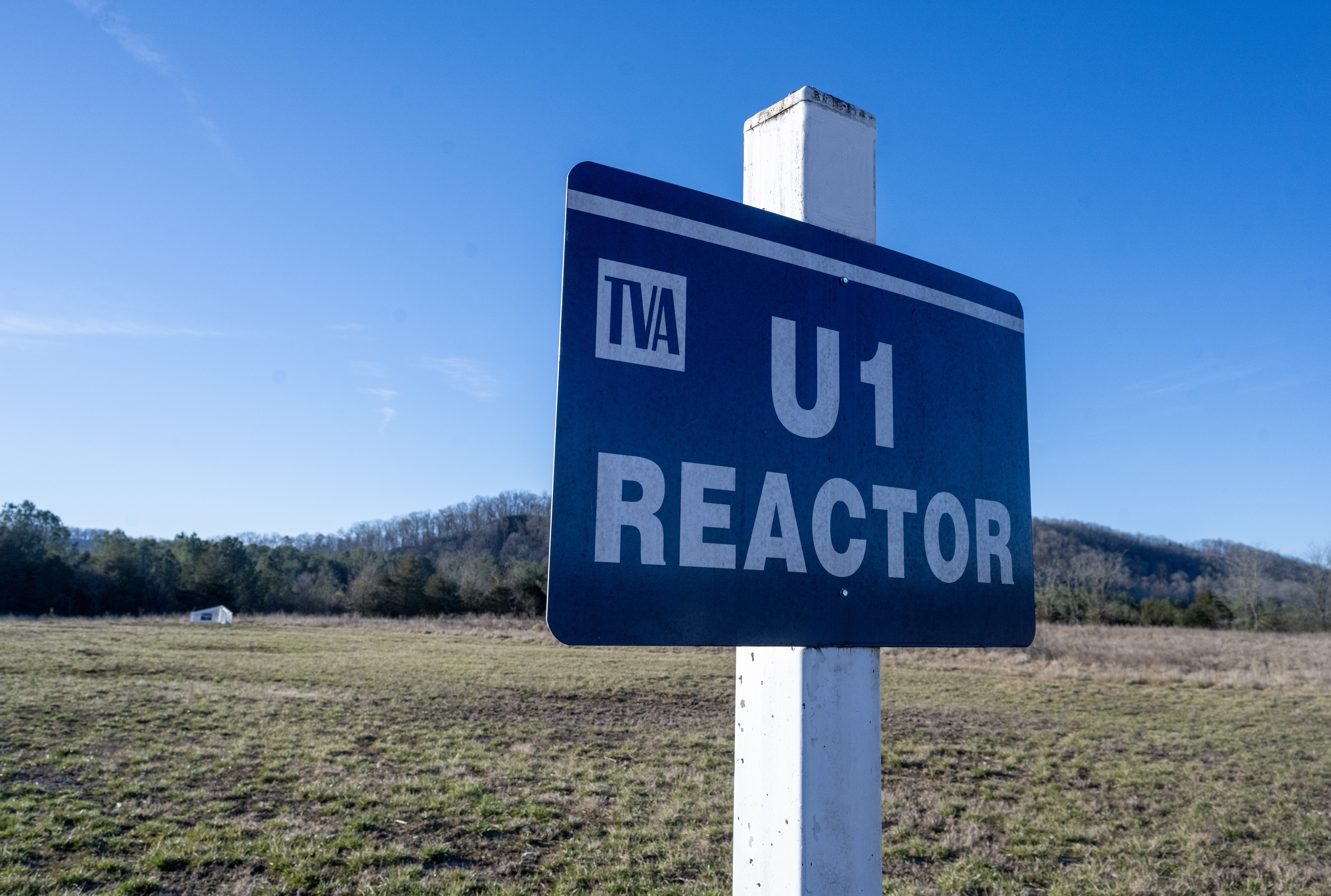
Among the largest projects moving ahead is GE Vernova Hitachi’s BWRX-300 Clinch River Project with the Tennessee Valley Authority. TVA is currently pursuing a construction permit for one unit, which is expected to be complete in the early 2030s. When fully completed, the site could potentially support more BWRX-300 units, adding firm capacity to the region..
Manu Sivaraman, senior vice president of new nuclear and transmission projects, said pursuing advanced nuclear makes sense for TVA because of its experience with nuclear, partnerships with research institutions, infrastructure and geography, and growing demand in the area. He said the Tennessee Valley has seen consistent annual load growth of about 2% and expects further growth as data centers open and people continue to move to the area.
“We know the demand is there, so using that ecosystem to leverage the next phase of growth is a natural next step,” Sivaraman said.
Backing the Momentum
Nichol said that the U.S. is at a pivot point in moving new nuclear from the research and development stage to delivery. This includes regulatory momentum, technology advancement, and broad state and federal support.
Nichol noted how data center developers have been getting involved in power purchase agreements for both advanced nuclear reactors and older facilities. While this support helps, he said measures such as those in the ARC Act, in which the federal government would share cost overruns on projects up to a certain point, are a helpful way of protecting ratepayers and de-risking projects.
“One of the biggest challenges for utilities to build new nuclear at grid scale is the uncertainty of the costs,” said Nichol.
“Predictability of first of its kind is difficult,” added Sivaraman.
To help, NEI has been compiling best practices around construction and development, including what steps help mitigate cost impacts.
White pointed to CATF’s Nuclear Scaling Initiative, which is similarly working to capture key deployment lessons that will help future builds be more efficient. “If we can improve on the budget and we can improve on the cost as we go from the first unit to the tenth unit, suddenly we're not building first-of-a-kind technologies that have cost overruns and schedule delays, but instead we can deliver nuclear power plant projects that are on time and on budget.”
Sivaraman said TVA has a partnership with the entities involved in the Darlington project, which is developing the same BWRX-300 reactor. With that project further ahead in construction, “that allows us to follow a lot of detail and incorporate their lessons learned as we go,” he said.
“A lot of the challenges with new nuclear are less about the technology and more about whether the site is ready to adopt any kind of technology,” added Sivaraman, noting the importance of having the supporting grid infrastructure and river system that can handle the cooling system for a reactor. He also stressed how TVA started the siting process years ago to allow for the necessary environmental reviews and monitoring.
Laying the Groundwork
Nichol said NEI’s continued efforts to educate the public about nuclear energy, focusing on the facts about safety and used fuel, has led to the public being increasingly supportive of nuclear energy. NEI surveys have found there is more support for nuclear than people realize. “In our public opinion surveys, if you ask people, ‘do you support nuclear energy?’ The majority say yes. If you ask, ‘does your neighbor support nuclear energy?’ most people say no. And so it's a misunderstanding of what other people think, largely because we don't talk about it enough.”
“Community sentiment here is overwhelmingly positive and filled with curiosity,” said Sivaraman, adding how state and local policymakers, including Tennessee Gov. Bill Lee, have been part of the effort to talk about the potential economic benefits of the development. Part of the curiosity and education is catching people up with the “layers of safety and regulatory processes” that have advanced in the decades since nuclear plants were last developed.

“You can never be too early with community engagement,” added White. “I think there are mistakes that were made historically in a lot of energy projects where you would pick the site first and then start engaging with the community. And what we've really seen is that's not a great way to build public support and public acceptance.”
Instead, he noted how developers start explaining the technology and the potential benefits early on, and then have the community weigh in on whether they think it will be a good fit.
“Public support for nuclear is greater near the facility than it is among the general population, and that's because nuclear power is such a good neighbor,” said Nichol, pointing to the economic and job benefits as well as environmental stewardship.
With advanced technologies expected to reach commercial readiness in the next five to ten years, White said the time to start assessing community sentiment and engagement is now.
“If you wait until the technology is fully commercially available to start having these conversations, you're probably going to be behind in terms of deployment,” said White.
Nichol and White also pointed to the need for long-term regulatory and policy certainty, and regulatory processes that make sense for more modern technology.
“The regulations were really designed in the 1950s and 60s and then evolved for large light water reactors. As we're talking about new nuclear technologies that might use new fuels or new coolants, some of those rules aren't applicable or really aren't appropriate,” said White. He noted how the NRC has been working for years to modernize its process to better fit the range of technologies, which has led to the designs advancing today. He sees the next step as ensuring the regulatory process allows for scaling once certain designs are approved, focusing on site-specific considerations rather than re-reviewing technology.
Don’t Sleep on Fusion
The next few years might finally put an end to the gibe that fusion generation is perpetually 30 years away from becoming reality. While still in the demonstration phase, development is moving ahead for the necessary permitting, design, and other planning around building fusion facilities in the U.S.
While designs differ, fusion technologies aim to create contained environments where atomic nuclei are joined, releasing energy in the process. White pointed to enabling technologies such as high temperature superconducting magnets, computing, high energy capacitors, materials science, and advanced laser technology as helping move fusion forward within the next decade.
Other signs point to concrete advancements in fusion technology. The Department of Energy created a standalone Office of Fusion as part of a reorganization announced in November 2025, a move to support increased domestic energy production.
TVA is among the entities working with Type One Energy to build a fusion prototype at the former Bull Run Fossil Plant site in Anderson County, Tennessee. The plant ceased its fossil fuel operations in 2023, and TVA and Type One Energy are looking to transform the facility into a 350-MW fusion plant over two phases. TVA believes this effort progresses the research and development of fusion for the United States.
Commonwealth Fusion Systems, a private company based in Massachusetts, has also moved ahead with plans for a nearly 400-MW plant in central Virginia. While CFS still needs to have the SPARC system that the plant would rely on demonstrate energy generation, it is confident enough in its progress that CFS applied for interconnection to PJM in April 2026. CFS expects SPARC to demonstrate net-positive energy in 2027, paving the way for the ARC plant to open in the early 2030s.
CFS’ plans for fusion facilities compare them to “the size of a big-box store with about the same site needs.” CFS’ website notes that its smaller land needs compared to other power generation sources, including wind and solar, “makes it easier to build near areas with heavy power demand, with significantly less development of transmission systems.”
While the ARC facility is being self-funded by CFS, it entered a power purchase agreement with Google in June 2025 for the tech giant to purchase 200 MW of ARC’s output. CFS is leasing the land for the plant from Dominion Energy.
White also stressed the broad industry and government support needed to help create the conditions for fusion to scale, including developing a fusion-tailored regulatory review process. “For a scientific demonstration machine, where you might have a limited amount of radioactive material or a limited amount of radiation being produced, maybe we can have a simplified regulatory system and simplified regulatory reviews because it doesn't represent any significant hazard to workers, the public, or the environment.”
Keep Options Open
Developing plans that don’t focus on any one technology also doesn’t mean sticking with yesterday’s generating mix.
Nichol noted that utilities often still equate nuclear with large reactors, but that advanced technologies will help more utilities be able to consider the right scale and fit for their community. Looking ahead, “it's not a requirement that the only way to get nuclear power is to collaborate with a bigger group to aggregate your loads,” he said. “If you're a small public power utility and you have a small power need, there is likely an advanced reactor that is sized for that application.”
“It's going to take a balancing act of different energy technologies with different attributes that help us get to the affordable, reliable, clean, secure — throw in your favorite adjective — energy grid that we're going to need in the future,” said White. And that means thinking about fission, fusion, and other technologies in development. “It's hard to predict today what technology is going to be best for the utility in 20-35 years, but if you leave those options open, it can maximize your opportunity to hit whatever your energy goals are.”
It’s also about laying the groundwork for growth and modernization of any kind.
“With time and distance from the previously existing nuclear plants to now, you’re also transitioning to a predominantly digitized power plant,” said Sivaraman. He stressed that means ensuring IT and other systems are modernized, and that transmission is ready for growth. “To supplement new power generation, you’ve got to have a transmission interconnection system and transmission system that can handle the growth, otherwise it’s a turbine spinning for no good reason.”