Utilities and grid operators are focused on making sure the electric grid can always meet demand. This is called resource adequacy. Ensuring resource adequacy involves short- and long-term planning, coordination, and maintenance.
Here’s a breakdown of key factors and challenges behind resource adequacy.
Enough Capacity
On the surface, this is a simple equation of whether there is more generating capacity in operation than the peak usage on high demand days.
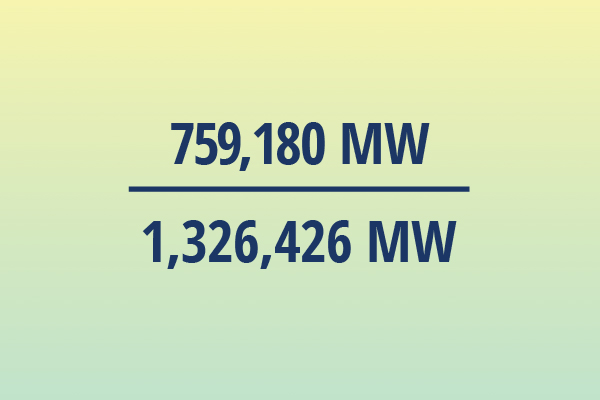 | U.S. peak demand, July 2025 |
Total U.S. nameplate capacity |
However, the nameplate capacity does not equal output, and operators are looking at how to better measure total capacity based on how often it gets dispatched. Worth noting that of the total U.S. nameplate capacity, only 870,600 MW is firm capacity.
Sufficient Transmission
As of early 2025, 468,582 MW of new generating capacity was under development, including 143,247 MW that have been permitted or are under construction. Since 2000, less than 20% of generation projects have been completed, in part due to increasing wait times to interconnect to the grid.
Building more capacity is one step, delivering the generated power to whoever will use it via transmission lines is another.
| As of January 2026, 41,000 miles of transmission lines were in some stage of development across the U.S. (through 2035) |  |
Of the 863 transmission |  |
Projects totaling more than |  |
Accurate Forecasting
With more variable generating capacity sources on the grid, operators need to predict not only how much load will be needed in the future, but when it will be needed. In many regions of the U.S., electricity demand tends to peak in the later afternoon during July and August.
Projected Peak Load Growth, 2026-2032
NERC's Long-Term Reliability Assessment projects peak demand to grow more than 170 gigawatts through 2032. However, this demand is not spread evenly across the U.S.
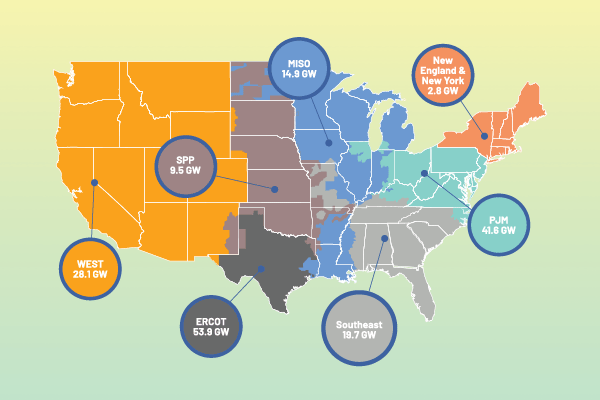
| Region | Peak Load Growth |
|---|---|
| ERCOT | 53.9 GW |
| PJM | 41.6 GW |
| West | 28.1 GW |
| Southeast | 19.7 GW |
| MISO | 14.9 GW |
| SPP | 9.5 GW |
| New England & New York | 2.8 GW |