
Energy storage has become a considerable part of the U.S. capacity picture over the past decade, bolstered by a combination of technical advancements, transmission cost, and policy support mostly focused on battery storage.
According to the U.S. Energy Information Administration, utility-scale battery storage capacity has increased 70% in each of the past three years, jumping from 9 gigawatts in 2023 to nearly 52 GW in operation at the end of June 2026. Another 54 GW of battery storage is anticipated to be brought online by the end of 2029.
As of 2024, systems owned by public power represented about 0.5% of all utility-scale energy storage capacity across the U.S., though many public power utilities contract with third parties to leverage storage assets. As the battery market and tax credit landscape continue to shift, public power, including smaller municipal departments, have been increasingly exploring whether direct ownership of battery storage systems will yield greater benefits for peak shaving and reliability.
Finding Stability
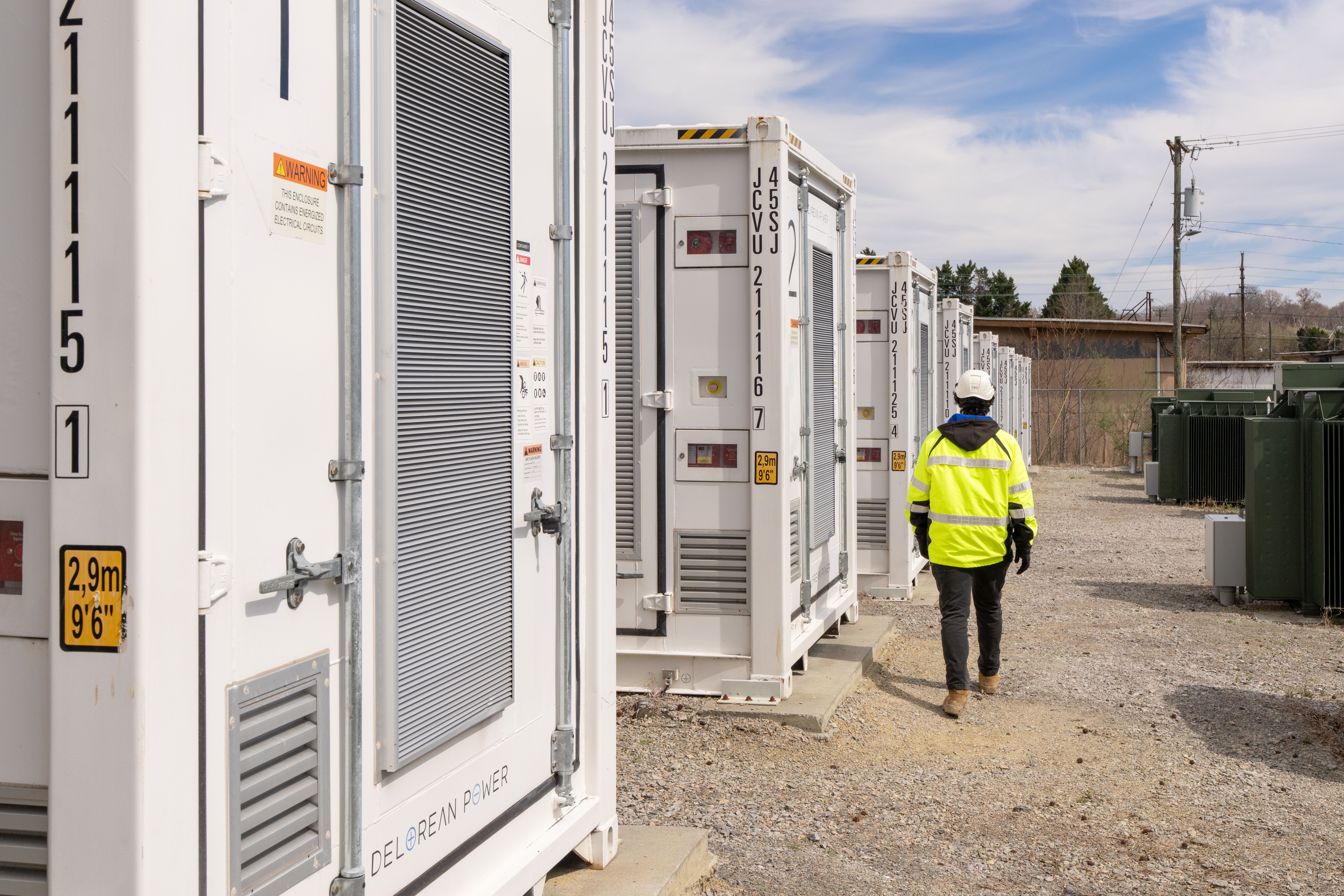
Virginia’s Blue Ridge Power Agency supports nine smaller municipal and cooperative utilities throughout the state. BRPA recently announced a partnership with Lightshift Energy to deploy a portfolio of five individual 5-megawatt battery storage facilities across Central Virginia Electric Cooperative, Craig-Botetourt Electric Cooperative, and the Salem Electric Department.
The joint action agency has taken a coordination and project planning role in the development of rural battery storage to get ahead of rising cost pressures.
“The number one reason we began looking into it was rising transmission costs, which have skyrocketed in the last decade or so,” said BRPA General Manager Alice Wolfe.
Wolfe noted that the rise in transmission costs has been “well beyond the pace of inflation” and estimated that BRPA, which serves utilities within the PJM interconnection, has seen these expenses quintuple over the past 15 years.

When the BRPA members first began looking at battery storage, several members were under contracts that prohibited them from bringing new generation online.
“The plan was that the batteries would be fully charged by [Appalachian Power Company], we would just discharging them at different times,” Wolfe said, “So, we wouldn’t be generating new megawatt-hours, we’d just shift when those megawatt-hours are being used.”
BRPA put out a request for proposal in 2021 that would support these five battery projects together. The RFP drew multiple industry submissions, and the JAA ultimately settled on Lightshift Energy.
“We went through serious negotiations with three different parties,” she said. “The battery market has been in flux over the last few years, especially with the release of the tax credits for standalone battery storage, which kind of threw a bomb into the middle of our negotiations.”
Wolfe said Lightshift Energy showed a willingness to take the projects on in part because working with public power is a strategic focus area for the company.
“Other developers were looking for larger installations, but Lightshift has a history of working with public power and already came with good recommendations from a nearby project in Danville, Virginia,” Wolfe explained.
The batteries are expected to go online before the close of 2026 and are forecast over their lifetimes to save BRPA’s member utilities around $100 million.
Wolfe sees the support BRPA has marshaled behind these smaller, rural battery installations as also being helpful in mitigating capacity costs, which have increased substantially in the PJM region.
“I’ve worked in public power for 15 years now, and we have always had the same message: We want our members to stabilize their rates, we want them to be looking at everything, and we try to get our rates as low as we can. We also want them to look ahead and make purchases that will help them stabilize their rates regardless of anything else going on. It’s just the right thing to do,” Wolfe said.
A Cost-Conscious Choice
Princeton, a town of 3,500 residents in central Massachusetts, is one of a handful of public power utilities in the state in the process of building its own energy storage.
Sean McKeon, general manager at Princeton Municipal Light Department, said the utility first began considering battery storage as a means of sustaining its low rates. “In 2020, we had a tight budget due to paying down debt on our two wind turbines. We had gone a few years without raising rates at that point, and we made it a goal to go as long as possible without changing that.”
PMLD previously rented a 2-MW peak-shaving generator that brought considerable returns over the summertime but would have been expensive to rent long-term. The utility was cautious about exploring capital-intensive projects after having recently invested in the turbines.
“We didn’t have a big war chest of cash, and we understood taxpayers in Princeton wouldn’t be tolerant of another big capital project like the wind turbines. So, I had to find solutions that wouldn’t cost us money,” McKeon said.

PMLD’s JAA, Massachusetts Municipal Wholesale Electric Company, began offering competitive solicitation models in 2022 that would allow the public power utility to bring battery storage online.
“[MMWEC] offered two ways to do it. One was a capital project where you bought the battery. The second was a shared-savings model, which all of the participating utilities — us included — went with,” McKeon said.
MMWEC also chose Lightshift Energy as its development partner, with both entities providing the support and resources needed to bring battery storage to six participating utilities.
“I didn’t have all of the technical knowledge, which MMWEC was able to provide. They also took care of the legal side of things as well, so we didn’t need to draw up our own contracts, either. It handed considerable cost and time savings to all of us,” McKeon said.
He added that PMLD does not have the expense of developing the project, since the way the model is set up means Lightshift develops, owns, and operates the assets, “while PMLD captures a portion of the savings without carrying the capital cost or the operating risk.”
The expectation is that adding the battery storage will help Princeton to sustain its “nine-year record of rate stability by reducing the transmission and capacity charges that make up a significant portion of our wholesale power costs,” McKeon said.
While PMLD is waiting for an accompanying transmission study to conclude before proceeding with the project, McKeon was confident the results will prove beneficial for the town’s rates and service quality.
“At the end of the day, we’re doing this to make sure our customers can continue to enjoy the same affordable rates we pride ourselves on,” he said.
Evaluating Opportunity
Other public power utilities are looking not only at utility-developed large-scale batteries, but also how to encourage organic distributed storage development in their service territories.
Newark, Delaware, was awarded a $250,000 grant in 2025 to study opportunities around public-private partnerships and the development of community-wide renewable energy and battery storage. The public power utility used the grant to consider how distributed battery storage could be integrated within its system, including the best financing and project management approaches.
A portion of Newark’s grant funding was used to conduct a study to determine the technical and economic impacts of distributed energy storage, and what kind of battery program could be feasibly developed to incentive customer installations.
As a first step, Newark examined how other municipal utilities had successfully offered battery incentives to their customers. “We looked at other utilities around the country at what kind of battery programs they had, specifically focusing on municipal utilities that were of a similar size,” said Lucas Beidler, distribution engineer at City of Newark.

The city also oversaw a wholesale regulatory analysis of the federal, state, and local-level battery landscape while modeling how the grid might accommodate, and benefit from, various levels of battery penetration. This culminated in financial planning evaluation to determine how the utility could benefit from distributed storage as well as how the utility could help customers fund installations.
As Beidler outlined, prior to the implementation of Federal Energy Regulatory Commission Order 2222, which will enable aggregated distributed storage to participate in the PJM ancillary services market, the greatest return on investment from distributed batteries would come from peak shaving. “So much of the power of energy storage lies in its potential for utilities to peak shave, especially as peak costs continue to climb amidst grid electrification, data centers, and other pressures. Doing an analysis to figure out how much money you can save from peak shaving is essential to understand when planning these projects.”
Other than a distributed storage program, Newark is also pursuing utility-scale storage and is in the stage of evaluating a project with support from joint action agency Delaware Municipal Electric Corporation, which has prior experience advising on similar projects.
“DEMEC just finished a battery project in Milford, Delaware, that went online this year. It’s got a solar soaking application and is doing peak shaving, and DEMEC is using their experience to help us as well,” Beidler said.
The city has settled on an initial investment in a substation battery it hopes will support both peak shaving and grid resilience.
“We’re in the early stages, but I would guess we’re looking at a 5-MW battery as our pilot,” he said.
As for financing, Newark is exploring the possibility of a performance contract where debt service on the corresponding loan is paid for by energy savings, which would mean little or no net cost for the utility.
Beidler sees this exploration of battery storage not just as an endpoint unto itself, but as a crucial step within a broader program of innovation that will help the public power utility to keep pace with technical and regulatory developments while allowing customers to participate. Beginning to encourage and utilize a portfolio of distributed storage today will enable future energy savings for the utility as the smart grid evolves.
“Some of our customers want to get involved with virtual power plants, and we want to support our customers being able to do that with things like bidirectional electric vehicle chargers. With FERC Order 2222 being implemented in our region by 2028, it will enable virtual power plants to participate in the PJM market. So, that’s the kind of timeline we would like to meet,” Beidler said.
Utilities developing energy storage can also review APPA's Public Power Energy Storage Project Plan Guide, a step-by-step overview of how to compile a comprehensive implementation plan for energy storage projects. The guide is the latest among APPA's catalog of publications on energy storage.