Every community across the U.S. is at some level of risk for experiencing a sudden loss of infrastructure and other damage, whether from an ice storm, hurricane, tornado, flood, wildfire, or other natural disasters. While public power utilities are especially diligent in addressing service interruptions, emergency events can bring widespread infrastructure damage that necessitates additional support and resources to get communities back on their feet.
Preparing communities to be more resilient is a complex calculation of potential risk, planning for grid hardening, and effective emergency response. Public power utility staff possess technical knowledge and understanding of grid systems, familiarity with the communities they live in, and relationships with other local organizations. As not-for-profit entities, public power utilities make these calculations with affordability for their communities top of mind.
Many public power utilities have benefitted from additional support from the Federal Emergency Management Agency, in the form of reimbursement and resources, as part of their recovery efforts. APPA members have also received FEMA grants to mitigate against risks and future natural disasters. This support and financial assistance has been invaluable to communities in recovery, helping utilities have more peace of mind in restoring essential energy services to their communities. Because this support is so critical, the American Public Power Association and its members have been supportive of efforts in Congress to reform aspects of FEMA, especially FEMA’s Public Assistance program, to remove administrative burdens and ensure that our members get the help they need as quickly as possible.
Unprecedented Damage and Loss
When heavy rainfall in early July 2025 caused the Guadalupe River to swell, Kerr County, Texas, took the brunt of the flash flooding, both in terms of loss of human life and ensuing infrastructure damage. For Kerrville Public Utility Board (KPUB), which serves over 24,000 customers throughout greater Kerr County, the event marked 2025 as one of the utility’s most challenging years since its municipalization in 1987.
Allison Bueché, director of customer and community relations for KPUB, said the damage to power lines was far greater than any prior disaster, including another major in 2020.
“In 2020, we had 30 downed poles, and last year we had around 110 from the flood. It was that much more of a significant event for us,” Bueché said.
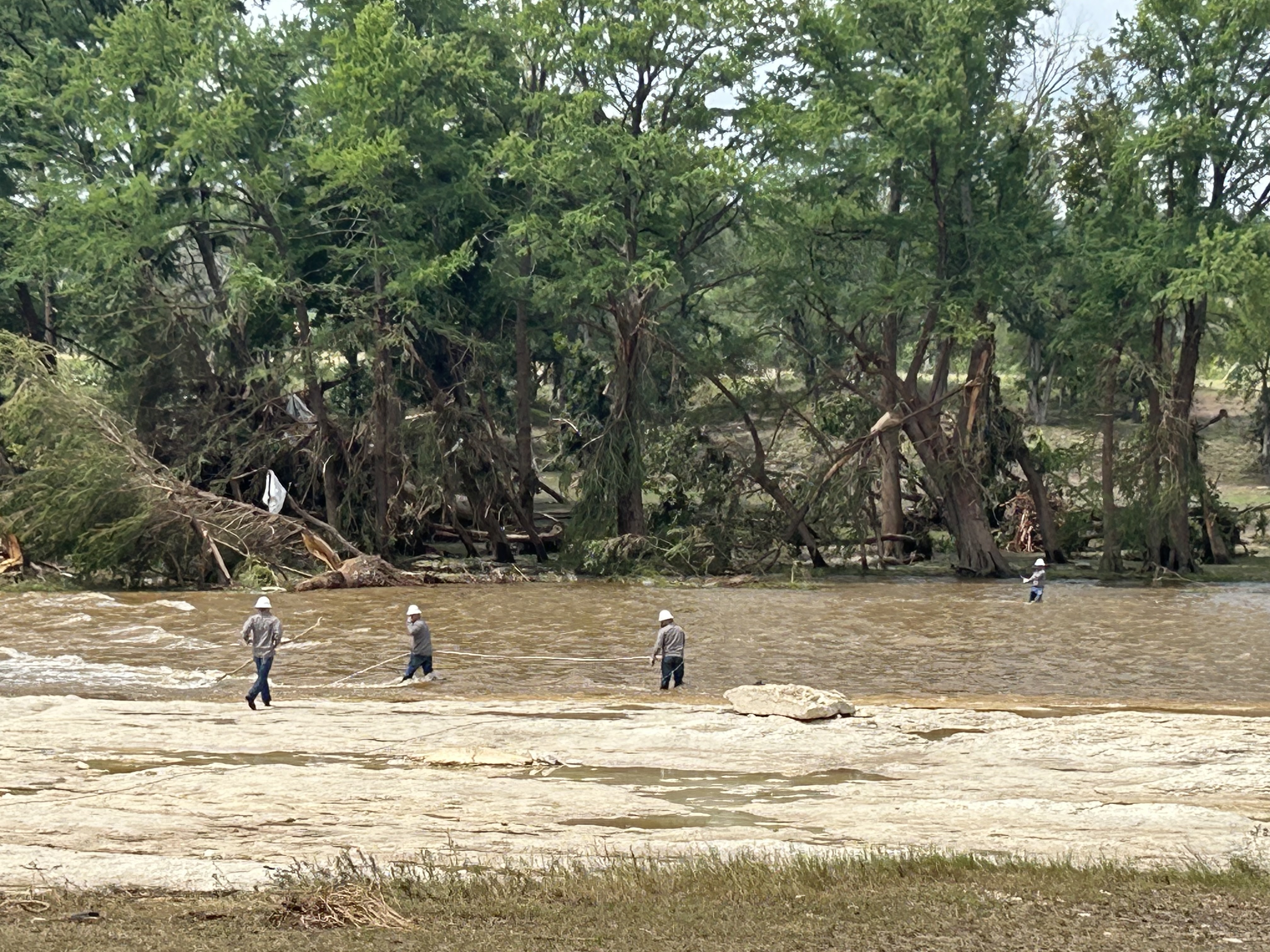
Photo courtesy Kerrville Public Utility Board.
The damage was so extensive that it prompted the utility’s first coordination with FEMA for disaster aid and only the second mutual aid request in its history.
Amy Dozier, assistant general manager at KPUB, noted that the federal disaster declaration for Kerr County for the flooding event, on July 6, opened up the option for public assistance to come through from FEMA.
KPUB staff took immediate action to restore service, using their expertise, mutual aid partners and closeness tothe residents of Kerr County to move with an exceptional speed. Dozier said customers were surprised by the quickness with which repairs began and service returned.
KPUB staff also found their customers were proactive and enthusiastic in providing material support, offering up kayaks and other items to help with power restoration efforts.
“We even got a call from a customer who said, ‘I have a drone if you need me to survey the damage for you,” Dozier said.
The close coordination and swift response further improved relationships between KPUB and the broader Kerr County community.
“It was obvious to our customers that we cared about getting everything restored as quickly as possible. And our customers provided a lot of good feedback for us during this difficult event,” Dozier said.
KPUB found the contacts at FEMA to be responsive, knowledgeable, and genuinely committed to providing the support and coordination it needed. Dozier particularly credited the FEMA program delivery manager assigned to their region, Ira Guzeman, with being helpful in navigating the Public Assistance program grant process.
“We've had a great experience with her, and she's been on the ground in Kerrville since August, meeting with us weekly. She's been instrumental in helping us get our claims for public assistance filed,” Dozier said.
While KPUB has found FEMA staff to be knowledgeable and supportive, it has faced challenges with the financial reimbursement process. KPUB staff expressed that the uncertainty around the reimbursement timeline is especially noteworthy.
“We’ve been left with two questions: when do you think this review will be complete and what is the timeline for disbursing funds. While there are people meeting with us every week, they’ve been telling us in full honesty that they can’t give us a clear timeline,” Dozier said. Dozier noted that expediting and clarifying the reimbursement timeline would be a helpful reform, especially for public power utilities that might not have KPUB’s level of resources.
“Communication about the timeline from here would be really helpful. Luckily, we're not in a position where we had to borrow money, but other entities could be in a position where they have to take out short-term loans. And it would be greatly beneficial to know what kind of timeframe they’re looking at,” Dozier said.
Learning the Process
While hurricanes might seem like an annual event for Florida, Ocala, an inland community which rests in the north-central part of the state between Jacksonville and Tampa, has historically been spared the devastation from hurricanes that coastal areas in the state face. However, a series of storms in recent years has led the City of Ocala Electric Utility (OEU) to coordinate with both FEMA and the Florida Division of Emergency Management on recovery efforts.
Through recent recovery experiences, OEU has developed ongoing relationships with both agencies to improve how it manages financial processing and documentation at the state and federal levels.
OEU staff have found their FEMA counterparts to be knowledgeable and attentive, particularly in providing guidance on the procedures for documenting storm damage and obtaining financial support.
“Hurricane Milton was my first time coordinating with FEMA, and I found them to be very helpful. We had two or three different staffers assigned to us, all of whom were informative, especially since I was still learning how their processes worked,” said Catherine Larson, financial operations manager at the City of Ocala.
OEU is one of the smaller municipalities in the state, and staffers have been dedicated to finding ways of streamlining the reimbursement process.
“We've recently been working with the state on the Florida Recovery Obligation Calculation, or F-ROC, program by the Florida Division of Emergency Management (FDEM) to simplify the disaster cost recovery documentation process,” Larson said.
OEU staff noted this program would expedite the grants and reimbursement process in ways beneficial to them and other public power utilities that might not have the resources of a larger municipality. Proposed aspects of the program include an early documentation review process that would effectively score and pre-certify organizations so they could receive quicker reimbursement.
“The program supports organizations by streamlining documentation requirements, providing faster access to funding and makes recovery more efficient, by avoiding a lengthy post disaster review process,” said Marie Brooks, utilities finance manager at OEU.
Another effort would streamline the document preparation process, reducing the burden of paperwork for communities in recovery mode.
“Instead of feeding into an Excel spreadsheet with formulas, [the state is developing forms] that will take in your information and prepare documents that give the actual cost up front. We’ve seen demonstrations and trainings on it, and it looks like it’s going to be very useful to have for the next hurricane,” Larson said.
As Ocala staff explained, OEU’s financial management and disaster recovery teams possess extensive knowledge of both internal processes and how to recover from hurricanes — expertise that has been honed by managing the local response to seasonal storm activity.
The utility’s hope is that FEMA will institute reforms that streamline reimbursement, particularly in developing processes that allow municipalities to know upfront what items are eligible for reimbursement.
“FEMA assistance allows us to prioritize the rapid restoration of services. But eligibility requirements are not always clear. This is where we work closely with FEMA and FDEM to determine eligibility. Their timely communication works great for us,” said Charlene Pollette, financial analyst for OEU.
Stronger from Experience
Omaha, Nebraska, sits in both Tornado Alley and the Missouri River flood zone. This confluence of risk has required employees of the Omaha Public Power District to build broad expertise in disaster response and risk management.
Tonya Ngotel, manager of emergency preparedness for OPPD, came to the utility in 2021 from an extensive career in disaster and emergency response. In the last five years, Ngotel has managed response to some of the most intense natural disasters the utility has faced.
The past two years have proved to be especially demanding for the utility and the city of Omaha.
“In 2024 and 2025, we had six federally declared disasters, two of which were the largest OPPD has ever seen as far as outage and in cost in our 80 years of service,” Ngotel said. “Just within those two years, there were multiple disasters, some building atop the others. We’ve had floods, tornadoes, high winds, and even a little bit of winter weather in there.”
Jim Karnik, manager of asset accounting for OPPD, noted that the utility has, on average, experienced a storm-related federal declared disaster every two years. Since 2019, he shared, the OPPD has seen nine declared disasters and activated its storm team on 28 other occasions.
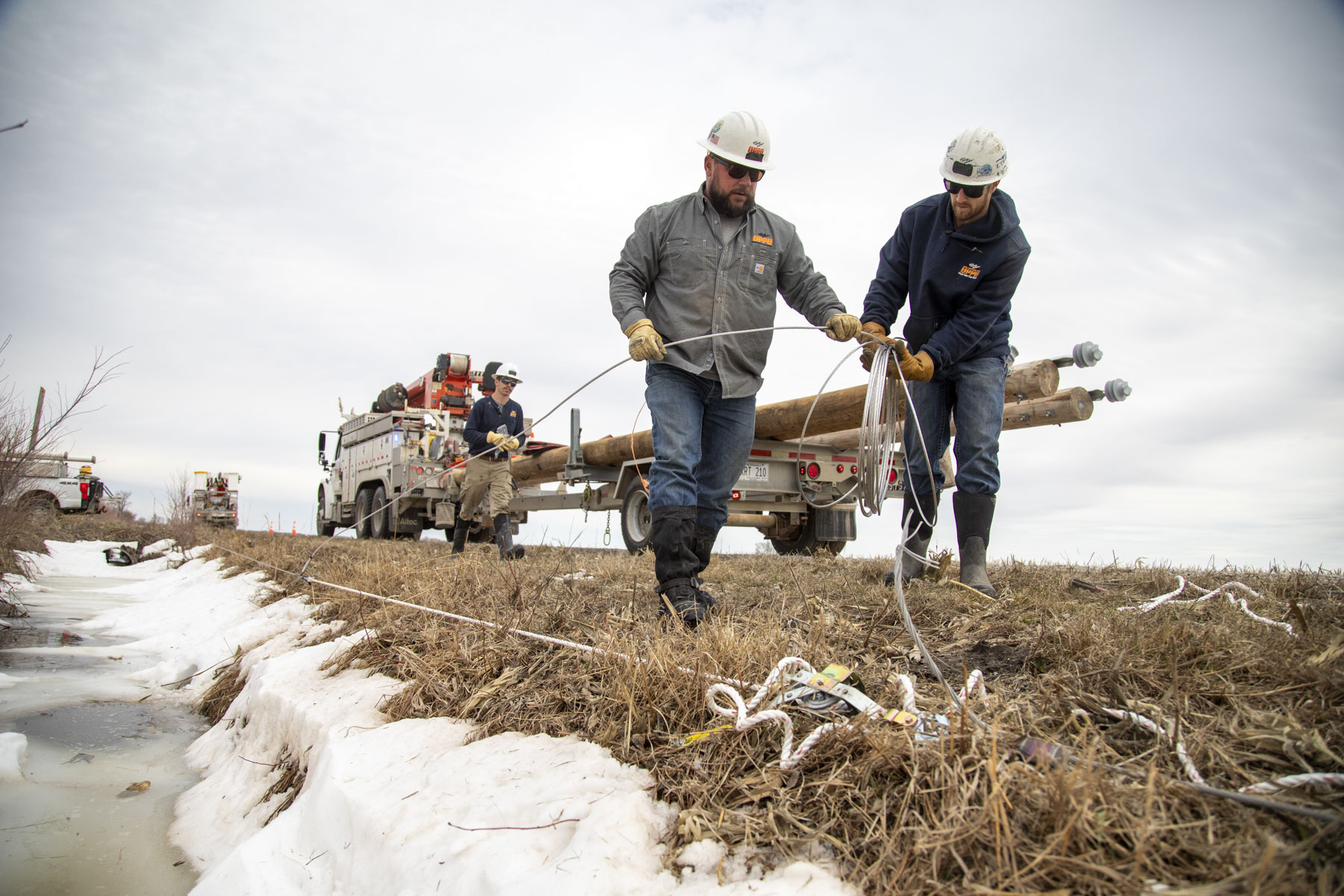
Photo courtesy Omaha Public Power District.
Ngotel noted that the disaster response team’s expertise and familiarity have allowed the utility to manage these events efficiently, including coordinating with the mutual aid network and other institutional relationships that OPPD maintains year-round.
“Through preparedness and mitigation efforts, based off FEMA’s phases of emergency management, OPPD works with local, state, and federal partners in developing a state of readiness. We’ve created this emergency operations center concept that’s able to support the field teams that are out there, and then able to communicate and coordinate with our state and federal partners,” Ngotel said.
“Utilizing the FEMA Public Assistance program allows OPPD to not only recover and repair critical infrastructure, such as poles and lines, after a storm, it also allows opportunities to mitigate future risks by enhancing facilities,” added Ngotel. As an example, OPPD was able to mitigate damage to its infrastructure from flooding in 2024 based on the experience and support received during major flooding events in 2011 and 2019.
Ngotel expressed appreciation for the level of diligence FEMA partners bring to disaster response and recovery efforts.
“FEMA has become a constant presence when the district needs federal support following a major disaster and helps keep the cost of power manageable,” said Ngotel.
“[Public Assistance program funding] helps keep our rates more affordable and our structures more resilient,” added Karnik.
As FEMA undergoes reform, OPPD hopes the valuable staff and institutional knowledge the agency possesses is retained, so that it is able to maintain the interpersonal relationships that OPPD and other public power utilities have built with their disaster response partners.
“We’ve encountered challenges with staff turnover and changes at the administrative and regional levels. When you have a lot of staff either leaving or coming on, that can hamper learning opportunities and lead to snags in information retention,” Ngotel said.
Karnik noted that clearer guidance for utilities — for example, clarifying the difference between a pole upgrade or needed repair during emergency restoration activities — could also help streamline the public assistance process.
On its end, OPPD has worked to ensure financial reimbursement paperwork is completed in a timely fashion to help make its federal partners’ jobs as easy as possible.
Ngotel also recommended that FEMA’s federal-level policymakers focus on incorporating the needs and experience of public power utilities, which stand at the forefront of community disaster response and serve over 55 million people in the U.S. and its territories.
“We have an opportunity to educate people. Emergency management is critically important, and emergency management within utilities is even more critical. I believe the opportunity is there, and we haven’t necessarily capitalized on that,” Ngotel said.