
[Editor's Note: this story was originally published in the May 22 issue of Public Power Current Extra]
The House Committee on Appropriations on May 20 passed 34 to 25 the Energy and Water Development and Related Agencies Appropriations Bill for 2027.
The bill provides $15.5 billion in funding for non-defense energy programs; an eight percent cut relative to the amount of funding provided for fiscal year 2026, but a reprieve from the 21 percent cut proposed by President Donald Trump in his most recent budget submission to Congress.
APPA reported that $1.7 billion of funding for FY 2026 was provided by re-allocating appropriations from prior years. As a result, while programmatic funding would decline from 2026 to 2027, the bill would actually increase new money appropriations in 2027 relative to new money appropriations for 2026.
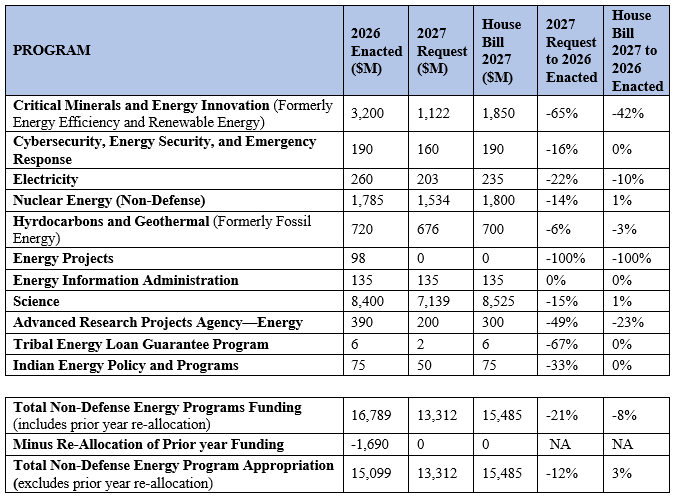
Passage of the bill followed the defeat of an effort to bring the bill in closer alignment to the president’s request.
For example, an amendment by Rep. Andrew Clyde (R-GA) to cut funding for the Office of Science by $1.86 billion to bring it in line with the President’s request was defeated by voice vote after Energy and Water Development Subcommittee Chairman Charles Flieschman (R-TN) strongly opposed the amendment.
A summary of the markup can be found here. The report accompanying the bill can be found here.
Data Center Amendments Receives Bipartisan Support
During the markup, the committee adopted just one amendment -- a bipartisan amendment including a number of changes primarily to the committee report accompanying the bill, rather than the text of the bill itself.
The report already directed the Energy Information Administration to develop a detailed proposal, including a cost estimate and timeline, for collecting data from data centers, including electricity consumption and the potential impacts on electricity costs, and grid reliability.
The report also called on the Department of Energy (DOE) to collaborate with other agencies and governmental partners to identify and mitigate against the effect of data center development on grid reliability, transmission and distribution system constraints, and ratepayers. However, in a bipartisan amendment adopted by voice vote, that direction was expanded to also consider the effects of data center development and operation on water. Likewise, the language was expanded to encourage DOE to “support a diverse set of energy sources for power generation at data facilities.”
In an unrelated section, the report also indicates that $25 million should be for planning, preconstruction, construction, and monitoring plans for enhancing threatened and endangered fish species affected by the Bureau of Reclamation’s (Reclamation) Central Valley Project (CVP) and State Water Project operations in Northern California.
The report also includes language expressing concern with the bypass of hydropower generators at Glen Canyon Dam and the importance of hydropower generation at the facility. In addition, the report directs Reclamation, in consultation with the Department of Energy and Colorado River Storage Project power contractors, to carry out a feasibility study on a selective water withdrawal system at Glen Canyon Dam.
The report contains several directives of interest to public power utilities in the area of cybersecurity beginning on page 123, including the following:
• In light of documented cyber targeting of utilities, including by state actors, the Committee encourages the Department to incorporate pilot programs with energy industry asset owners and operators able to demonstrate active defense cybersecurity protection.
• The Committee directs the Department to work closely with stakeholders, including electric utilities and technology providers, to implement robust cybersecurity measures, conduct regular threat assessments, and ensure that state-of-the-art cybersecurity technologies are deployed to harden grid infrastructure.
• The Committee directs the Department to assess opportunities to leverage AI-enabled and automated cybersecurity compliance and risk management tools to support CESER programs, including assistance for rural, municipal, and cooperative utilities and secure collaboration with industry partners.
• The Committee directs the Department to provide not later than 180 days after the date of enactment of this Act a report on its ongoing and planned pilot activities, findings, and recommendations to assess and deploy automated cybersecurity compliance and third-party vendor risk management tooling.
• The Committee directs the Department to support advanced cyber and grid monitoring, analysis, hardening, and coordinated response to ensure energy security and the operational resilience of defense critical energy infrastructure and other critical assets.
• The Committee directs the Department to continue efforts to collaborate with universities and relevant industry and associations to enhance the Energy Threat Analysis Center to better incorporate small rural utilities and communities.
• The Committee encourages the Department to support sector-based initiatives that coordinate accredited third-party cybersecurity certifications for equipment and services deployed in energy utility operational technology, industrial automation and control systems, and utility tele communications environments.
• The Committee directs the Department to establish plans, including time frames as appropriate, to guide Departmental efforts to develop solutions and support for addressing transformer supply chain challenges and to guide the Department’s support for utilities and facilitate greater participation in industry sharing efforts.