Amid rising, rapid interest in developing data centers, these prospective customers are branching out from historically concentrated areas of development and looking at less populated areas with room to grow. Before breaking any ground, reputable developers seek to build partnerships with the community to ensure projects will be well received.
Sitting at the intersection of both electric infrastructure needs and community interests, public power utilities offer unique advantages that can be beneficial for data center development.
In July 2025, the U.S. Department of Energy announced four sites selected for artificial intelligence infrastructure on DOE lands: Idaho National Laboratory, Oak Ridge Reservation in Tennessee, Paducah Gaseous Diffusion Plant in Kentucky, and Savannah River Site in South Carolina. The locations were chosen for the private sector to deploy AI data center and generation projects. Three of the four sites are adjacent to public power service territories. Savannah River Site is adjacent to both an investor-owned utility and a cooperative.
A Positive Partnership
Sarah Wheeler, external affairs manager at Idaho Falls Power, said INL has been a good partner with the public power utility and the community they share. “They’ve been based in this community forever [and] are committed to the community as well,” she said.
Wheeler said INL held a data center meeting in 2025 that included different companies and communities that have data centers. INL also invited Idaho Falls Power to discuss how data centers could affect the community.
Speakers from communities that had data centers in them were able to talk about what it looked like and what were some of the pros and cons. “That has been really important as we engage in this dialogue.” Wheeler said.
“When we’re looking at what does a good partnership entail, I think it comes back to the basics that we talk about for almost every project: clear, continuous communication around what's really happening. What are those projected load forecasts? What are the timelines? It’s not news to anyone that getting any kind of infrastructure is taking longer and longer.”
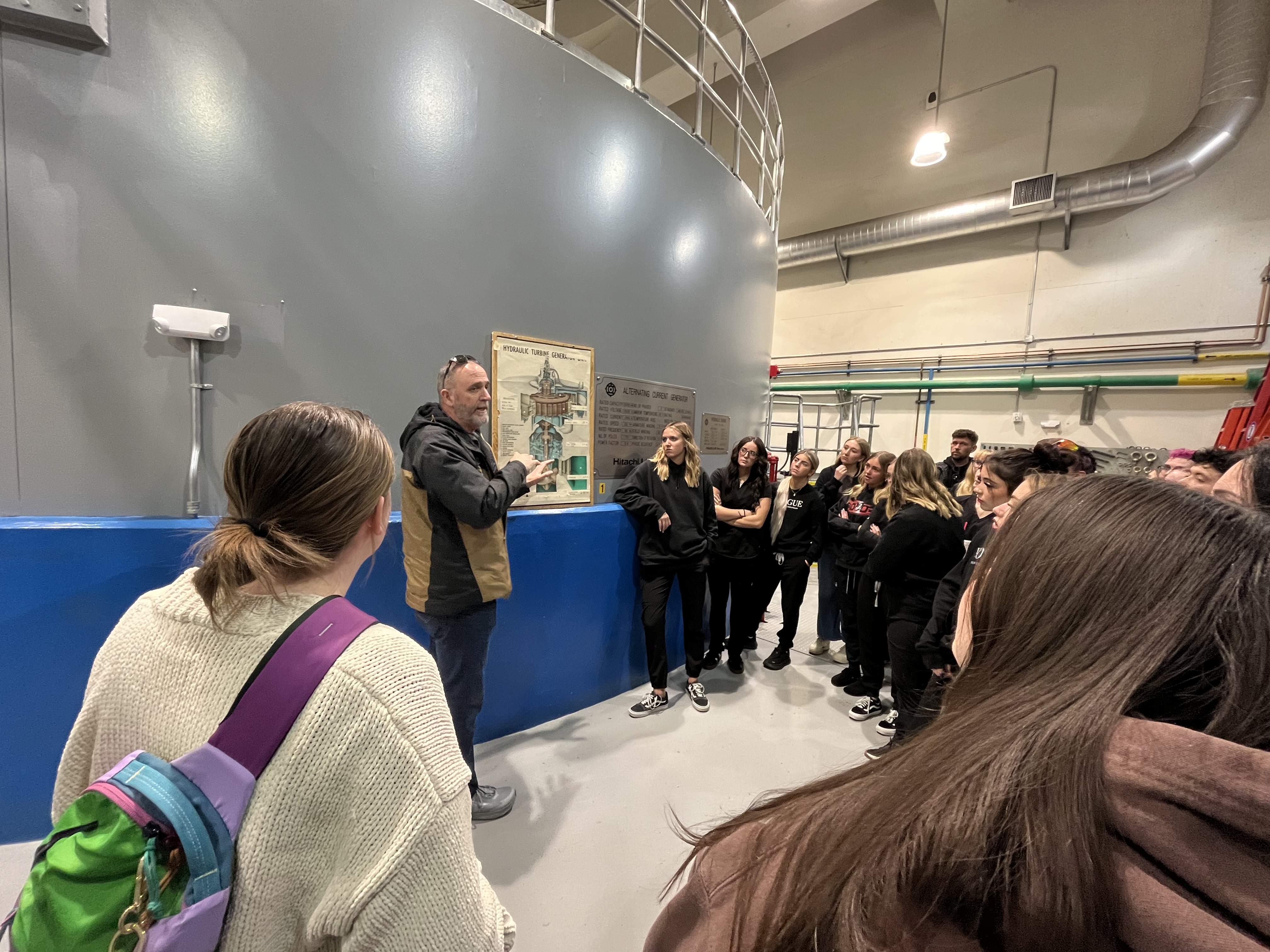
Photo courtesy Idaho Falls Power.
Jace Yancey, Assistant general manager of operations at Idaho Falls Power, noted that a substation transformer typically entails a two-year lead time, and there are other components “that you have to make sure that you prepare well in advance, so the collaboration is key to making all of this work,” he said.
Communication is also key, Wheeler said, noting that the utility holds meetings with INL to go over projects. “It’s really good to have those meetings so the utility can ask the questions like, ‘What do you really think is going to happen?’ That way, we can really plan ahead,” she said.
Another key to partnerships is a “commitment to reliability and resilience,” Wheeler noted.
“We live in this community; what affects it, we want it to be positive in perpetuity,” she said, adding that with INL developing the project, there are no worries about stranded assets or leaving the community out of decisions because the INL is a committed partner and community player.
Wheeler noted that one area important to the relationship is being upfront about cost — not just the total price tag, but who’s responsible for paying for which aspects of the necessary infrastructure to support a data center. “It’s expensive to have transmission and distribution. It’s expensive to have grid reliability.” She stressed that this development shouldn't be shouldered by existing customers.
Finding the Right Fit
Carl Rees, manager for economic and community development at ElectriCities of North Carolina, said communities served by public power offer several advantages when it comes to successfully developing data centers. ElectriCities provides power supply and related critical services to over 90 community-owned electric systems in North Carolina, South Carolina, and Virginia.
If you reverse roles “and you think about yourself as the business or the data center, the more different entities that you have to deal with to put a project together, a specific data center project, or maybe it's some other kind of business, the more complex that is,” said Rees.
“You have to deal with the regulations and timelines of all these different entities. If you think about public power, what that actually means is these are towns and cities. So the towns and cities typically also have water, sewer, some of them have gas functions in addition to the electric on the infrastructure side,” he said.
“They are also in charge of the land use and the permitting for projects as well. What we've seen is if you have a public power community that is interested in information technology and data center investment for their community,” as a community “you actually can do the work yourself to set yourself up well, to market yourself as a community that's friendly and ready for information technology investment,” Rees said.
The suite of responsibilities and local control is a distinct advantage of projects setting up in public power communities, said Rees. It also means communities served by public power can better position themselves for the type of development that fits with their community.

“You have local control of determining [what] sort of investment and infrastructure [you’d like to see] in your community, and then you can prepare for it and go out and bring it in,” he said.
Data centers “are nothing new to North Carolina,” he noted. Apple placed a data center in Maiden, North Carolina, one of the smaller public power communities in the state, in service in 2009.
That doesn’t mean these communities are suddenly seeing a spike in power supply needs.
“In their original incarnations, and still to some extent today, the model that we've actually seen is to have the water and some of the other resources, potentially gas and other, served by the public power community and the electric served by another provider,” he said.
Rees noted that a large data center being developed by Compass Data in Statesville, North Carolina, will involve Duke Energy providing the electricity needed for that project and the city has agreed to provide all of the other utilities. However, other projects in the works in the state include communities which will support the electric needs of the data center, both large and small.
“There’s a series that we're looking at that are smaller co-location data centers. When I say smaller, probably ultimately maybe 40- or 50-megawatt versus some of the hundreds of MW data centers and hyperscale campuses that we see. But we are also looking at some hyperscale data center campuses as well.”
These decisions vary from community to community, he said. “It's very important that communities not go blindly into this particular sector.”
There are “certainly some advantages to information technology and data centers, but if you're a community that needs people to go to work, that’s probably not going to be a great sector for you, because data centers, they employ some more people now than maybe they used to, but you're still looking at 50 or 100 people.”
If a community has “hundreds of people that are underemployed or unemployed, it’s probably not what you need to be looking at. You need to be looking at something larger.”
If a community is facing constraints on some of its utilities, “you may want to look at that because do you want to put all your eggs in this basket and not be able to bring a job producer in in the future and have power or gas or water/sewer for them? You need to think through those issues as a community carefully and have a plan,” he said.
Rees attributed the driving interest for data centers in North Carolina to a combination of having both a fast-growing population and having fewer resource constraints than other areas of the U.S., including access to water supply.
“Similar to some other parts of the country, our electric transmission system is a bit constrained, but at the same time, we do have power availability in some key parts of the state, and so we’ve seen that drive some data center development.”
In addition, Rees said the state has an excellent established fiber network.
The backbone of “what you need — the power, the fiber, the people — are all here in the state, and so I think that's driving a lot of the development that we see.”
Building on Trust
“Idaho Falls Power has a very good understanding and culture of customer service. We understand that we exist for the community because of the community and they truly are the reason why we’re here doing what we do. Whether it’s a data center, whether it's a municipal broadband network, whatever it is, when you have an entity that understands that it’s very beneficial to the community and to anybody that you partner with,” Yancey said.
Beyond being a collaborative partner, Yancey said, the city is “very open to new ideas.”
“Our community has a long history of supporting public power in general,” Wheeler said.
She noted that INL is a large employer and “we have a really good, educated, strong workforce in Idaho Falls and I think that pays dividends into how you promote economically within the community and how you continue to develop these higher-value, sometimes controversial, projects because people are able to look at the solutions and figure out how to move forward.”
Moreover, “I think that the community trusts us and they trust the INL,” Yancey said.
“They have a history there of those entities always being able to deliver the things that they need.”
Being a trusted community entity is key in ensuring community support, he said.
Wheeler noted that public power “is focused on people over profit, and we don’t want to do anything to jeopardize that trust,” because at the end of the day, “we exist because of them. And our main goal is to make sure they have safe, reliable, and affordable power. And that's never going to change with anything we bring in. We want to maintain that trust and transparency.”
Rees echoed the experience of developers approaching with a mindset of partnership with the community. He noted that sometimes data center developers can be portrayed as bullying their way in and not involving the community. “That is far from what we've experienced. We've experienced the opposite,” Rees said.
“We have found in our somewhat limited and newer experience that the private sector partners that we're dealing with are interested in partnerships, are interested in finding solutions that work for the community. And, of course, work for them as well.”
“We have experienced a level of inquiry about whether this is appropriate for the community, about what the community has done to prepare,” he added. He shared examples of data center developers asking about whether colocation with infrastructure such as a water treatment plant could supplement the project or what studies might make the development more palatable for the community.
Rees said that the process has “been somewhat of a learning curve” for both developers and utilities.
ElectriCities is working to guide member communities as it relates to data centers.
“We have had to ramp up our own education and knowledge and network in the data center industry so that we could serve as that vital partner to our members across the state of North Carolina,” Rees said.
The American Public Power Association’s report, What Public Power Needs to Know About Serving Data Centers, offers more examples of how public power utilities are managing the load growth driven by data centers.