The Environmental Protection Agency has issued the final version of revisions to the New Source Performance Standards for stationary combustion and gas turbines under Clean Air Act (CAA) section 111(b)(1)(B).
These revisions are codified in 40 CFR part 60, subpart KKKKa and apply to sources constructed, modified, or reconstructed after December 13, 2024.
The rule became effective upon publication in the Federal Register.
Based on an initial review, EPA has revised the subcategories and standards to recognize the capabilities and cost-effectiveness of nitrogen oxide (NOx) controls for various combustion turbine models typically used in the power sector.
EPA thus adopted subcategorizations based on (1) size; (2) 12-month capacity factor; and (3) efficiency of the turbine.
The size subcategory thresholds are the same as the proposal (small: less than or equal to 50 MMBtu; medium: (greater than 50 and less than or equal to 850 MMBtu/h; and large: greater than 850 MMBtu/h).
The utilization subcategory was revised from the proposal, however, as follows: high utilization: greater than 45% 12-month capacity factor; low utilization: less than or equal to 40% 12-month capacity factor.
The new, efficiency subcategories are: high efficiency: greater than or equal to 38% (presumably corresponding to large, advanced class turbines); and low(er) efficiency: less than 38%. (presumably corresponding to smaller frame combustion turbines – e.g., E-Class and F-Class turbines – and aeroderivative combustion turbines).
The final rule sets the following NOx emission limits based on size and utilization subcategory (EPA table):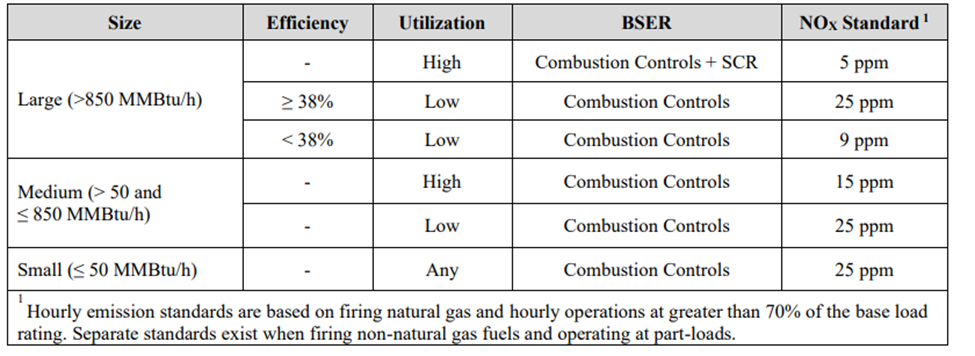
In a departure from its usual approach, the EPA chose not to quantify the monetary public health benefits of its final rule, arguing that current methods for estimating such benefits are too uncertain to rely on in regulatory decisions. The agency stated in its economic analysis that, given the significant economic impacts of environmental regulations, it must have strong confidence in benefit estimates before using them.
The final rule also incorporates a series of additional provisions intended to enhance clarity, flexibility, and consistency across the turbine standards. EPA created a new subcategory specifically for temporary turbines, recognizing their unique operational profiles and limited deployment periods. The agency also clarified that “part load” operation refers to conditions at or below 70 percent of a turbine’s base load rating, providing a more precise threshold for compliance purposes. For units that rely on byproduct or unconventional fuels, the rule allows site specific NOₓ standards, enabling tailored requirements that reflect the characteristics of those fuels.
EPA further determined that emergency operations should be excluded from utilization calculations, ensuring that infrequent, safety driven operating hours do not affect subcategory determinations. The existing SO₂ standards from subpart KKKK are retained without modification. In addition, the rule maintains a Title V permitting exemption for sources that are not major sources under the Clean Air Act. Finally, EPA adopted several amendments to subparts GG and KKKK to improve consistency and operational flexibility, including updates to monitoring, reporting, and exemption provisions.
Several of the rule’s provisions may draw scrutiny in anticipated litigation, as stakeholders evaluate whether EPA’s decisions are adequately supported by the administrative record and consistent with the Clean Air Act.